Wolves! Merely mentioning this canid species cansend chills up the backs of many people. They view wolves as perfect killingmachines - relentless and ruthless. Yet others see wolves as nature'sperfect animals which are always in balance with their surroundings. Which are they? As a research biologist, I have found that wolvesare neither super beings nor simple-minded organisms programmed by natureto react only through primeval instincts. My personal experienceswith wolves, both in captivity and in the field, have taught me they maybe something quite different than what we imagine them to be. Anencounter I had with the wolves I study in northwest Montana will illustratethis point.
 |
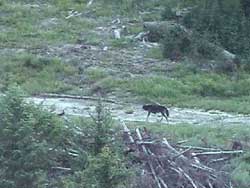
On a warm July evening, as the sun was setting, I sathidden in the woods listening to the howls of the Fishtrap pack. Several months earlier, at least seven pups were born which had made theFishtrap pack one of the largest in Montana. Because of my work,it is also the most studied pack in Montana. This includes my documentationof pack members lost due to human-caused mortality. On this evening,however, I was the only human near the wolves as they trained their pups. Several hours earlier the pack had separated into two groups, about a halfmile apart, each consisting of adults and pups. One of the groupswas only several hundred yards away. So instead of standing nextto my ATV on the logging road as I usually would, I walked about 50 feetinto the woods and found a nice grassy slope on which to place myself andmy equipment. On the ground next to me lay a parabolic dish and microphoneattached to a tape recorder, which I used to record the wolves' howls asthe two groups communicated through the air. I also had my radio-telemetryequipment so that I could hear the continuous signals of the three radiocollared wolves in the pack. There was at least one collared wolfin each of the two groups.
My study of the Fishtrap pack, called Project HOWL (Helping Our Wolves Live), utilizes radio telemetry to locate the collared wolves at specific locations. Although useful, this kind of data does not tell me if the entire pack is with them or has dispersed to some other area of their territory. The terrain in northwest Montana is quite variable, but what is constant is the great number of trees. The forests are often thick and observing the wolves is impossible. The U. S. Fish and Wildlife Service, the agency of the federal government that oversees wolf recovery in Montana, Idaho, and Wyoming, uses aircraft two or three times a month to fly over northwest Montana and listen for the signals of collared wolves. Over time they can deduce the range of a pack's territory and arrive at population estimates of the wolves in the recovery areas. Virtually nothing is learned, however, about wolf behavior such as social interactions, pack structure, utilization of resources, travel routes, seasonal shifts within their territory, den sites, rendezvous sites, and the wolves' interactions with local ranches and livestock. Such information can only be obtained from studies on the ground, like Project HOWL. So on this particular evening, I had used radio telemetry to locate the pack and figure out which of the collared wolves was with each group. I then sat hidden in the trees to record their howls. At the time I was thinking what a silly notion it was to hide from the wolves. Even if they didn't see or hear me they could always sniff me out. A wolf's sense of smell is many thousands of times better than our own so the grassy slope was more of a comfortable place to sit rather than a hideout. Besides, this was the Fishtrap pack.
Over the past four years, the pack and I have developed a working relationship. I find them most days of the year and study their behavior. They tolerate my presence. I make a conscience effort to keep my distance and not intrude on their daily activities. By now they probably know the sound of my truck and ATV (although I have no evidence that they actually care), and most certainly my smell. I even leave them an occasional urinary message on which they occasional leave a scat-like response. Other than that, they go about their business as if I weren't there. On several occasions we have met by mistake, usually when I am driving down a road they happen to be on. From the reports I have received from the surrounding community, this is not an uncommon occurrence. Today, however, I was near their first rendezvous site of the season.
 |
During the summer months, rendezvous sites are temporaryliving areas where instead of bringing food back to the pups, like at aden site, the pups are moved to the food. The pack may be at eachsite for perhaps two to three weeks before moving on to another one whichthey will do throughout the summer. These areas provide not onlyfood for the pack but act as training areas in which the pups learn futuresocial skills, hunting techniques, and in general become functioning membersof the pack. By fall, they will have matriculated into the pack'ssocial hierarchy just in time for the nomadic part of the year which canlast into late spring.
I was documenting the adults' practice of training their pups by breaking up the pack into several groups. I've documented this behavior each year I've studied the pack and when encounters occur it is usually this time of year. By July the pups are about 50 pounds in weight and as tall as a medium-sized domestic dog. Each year the new litter seems get a tour of their surroundings and how to utilize resources such as prey, water supply, travel routes, and the necessary knowledge to survive on their own. Winter is only a few months away and if they do not learn fast enough or have some kind of physical handicap, they will most likely die. Therefore, the pups' training period appears to be short, concise, and to the point. Finished with my work for the day, I had slipped out of the forest and back to the ATV. It was now almost dark, but I was waiting as long as I could so that the closest group of wolves would move on before I drove by them on the way home. I eventually packed my gear into the equipment box on the back of the ATV and began driving home. Apparently I did not wait long enough.
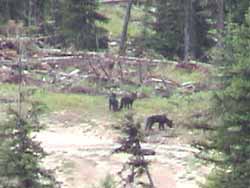
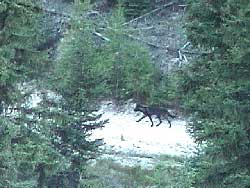
I had driven only several hundred yards when two black wolf pups jumped onto the road in front of the ATV. Barely within reach of the headlights, they stopped and looked at me as I slowed down. They seemed to wonder what I was but quickly decided that running in the opposite direction was the preferable thing to do. Through the darkness I barely saw the outlines of their bodies race down the road and around a corner that gently curved to the right. A small forested knoll blocked the far end of the corner, and the pups disappeared behind it as they ran. At that moment another wolf, an adult, slashed across the road and into the woods somewhere near the forested knoll.
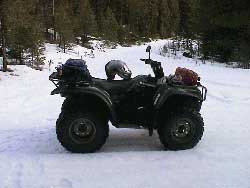 |
By now I had stopped and turned off the engine. I removed my helmet and entered a world of complete silence. I saton the ATV patiently waiting for the wolves to move out of the way so thatI could proceed homeward. When I encounter wildlife on the back roads,especially the larger animals such as bears, moose, elk, and even wolves,I stop and remain quiet inside my truck until they have moved on. In this case, I was exposed to the environment, so I sat there absorbedby the peacefulness and quite. This was my inner world of contentment,however, not the wolves'. Their world was disrupted by me.
Sounds of breaking of twigs and rustling leaves quickly broke the silence. I presumed it was the adult wolf coming to inspect why I was parked in the middle of the road and had not moved on. Usually wolves are stealthy, quiet creatures and it would be almost impossible to even know if one was near you. These characteristics make them extremely difficult to study. Not on this night. The wolf deliberately made noise as it approached which told me that it was not in a good mood and that obviously not all of the wolves were going to get out of my way. I heard the wolf cross the back side of the wooded knoll and then the sounds stopped. Again, I was engulfed in silence.
I glanced at my watch and realized that only two minutes had elapsed since the wolf pups first jumped onto the road. This was not long enough to proceed onward, especially when at least one wolf had approached even closer. I wanted to preserve my relationship with these animals. Making additional noise or potentially "threatening" movements that would all be associated with me would further jeopardize years of work. I knew then that I could be at this stop for awhile and I wanted to document anything that happened. I got off the ATV and took out my video camera from the equipment box and walked a few feet away from the ATV. As I did so the wolf began barking.
 |
A barking wolf is an agitated wolf. They usual howl. I had obviously come too close to the pups and this wolf had gone far outof its way to let me know that this situation was unacceptable. Ihave studied wolves for years, both in captivity and in the wild, so Iknew this was not an attempt to attack me, despite the fact that pups wereinvolved in this encounter. It was a warning that deserved a respectfulresponse on my part so I did not move from where I was videotaping. The wolf did not growl or act aggressively in any other manner.
As the wolf proceeded to confront me, I began to laugh. I couldn't help it. This "ferocious" predator sounded like a German Shepherd. I couldn't help but think that people's fear of these animals is so unfounded. A mistake had happened this evening, and the wolves and I were only negotiating our way out of it. So the wolf stayed at a comfortable distance and gave me its opinion of the situation. I also knew that no one was going to believe this so I used my video camera in an attempt to record the wolf's behavior. The camera had a "night shot" feature and with the infrared beam I could easily see into the surrounding woods but not the wolf. It was hidden behind the trees about 50 - 60 feet away. As I videotaped the darkness and listened to the wolf, I began to understand what was really happening and focused in on the efficiency of these animals.
The wolves were simply extracting their pups from a potentially harmful situation, at least from their point of view, and I was there to witness their plan unfold. After several minutes of barking a second wolf began howling. It was also fairly close and just on the other side of the forested knoll. The cacophony of sounds boomed through the forest and echoed off the mountain sides. So much for the silence. Presumably the second wolf was contacting the remaining wolves whose group was still about a half mile from us. I figured that I had about ten minutes before they arrived and I wanted this barking wolf to understand that its efforts would not be in vain. Therefore, my plan was to leave while the wolf was still barking at me but not until I fully documented our encounter. I was witnessing a wolf pack at the peak of its efficiency, an amazing thing to experience.
At the moment I encountered the pups on the road, the wolves' resolution of the encounter was set into motion. Within seconds the pups where escorted out of the immediate area. Instead of every one running away, however, the adults took a more proactive stance. At least two of them approached and the bold, noisy wolf confronted the potential "threat" and began to bark. Shortly thereafter, a second and nearby adult began to howl for help. So within only a minute or two several pack members covered all the immediate contingencies: remove the pups, confront the threat, and yell for help. What followed was an assessment of the situation by both parties, myself and the wolves, on what was really happening and what to do next. The situation could escalate or be defused. Neither side seemed too fearful of the other. I chose this time to leave the area, knowing the pups were most likely out of the way, and I could demonstrate my respect for the wolves' wishes - by leaving. Subsequent surveys in the succeeding days demonstrated that the wolves had not moved and everything was back to "normal."
 |
Wolves are complex creatures. Like humans, theyfeel pain, pleasure, fear, a sense of loss, and display a remarkable intelligenceunmatched by most living organisms. When pushed to their physicaland psychological limits, they can even suffer psychological disorderssimilar to those observed in people. Their place in nature is equallyas complex. They are not the marauding killers that some people believenor are they mindless and unfeeling chess pieces to be moved about withoutconsequence in the game of wolf recovery. My encounter with the wolvescould not have been experienced from a plane. Radio telemetry fromthe aircraft would have told me how many collared wolves were present butlittle else. I would have missed the entire point of what it is tobe a wolf.
Conducted on a daily basis, however, radio telemetry has helped supplement my knowledge of the Fishtrap pack. For example, the adult male is the collared wolf that is usually gone the longest and goes the farthest away from the rendezvous sites. The collared female leaves as well but does not go as far as the male. The collared juvenile leaves the least and travels the least. This kind of information, in conjunction with knowing the pack's travel routes, den site and rendezvous site locations, has helped me predict where the wolves are likely to be and prevent conflicts with people and their livestock. Interacting with agency biologists, such as those from the U. S. Forest Service, has also been helpful. It has afforded the Fishtrap pack some protection in regards to their den site and rendezvous sites which are on Forest Service land.
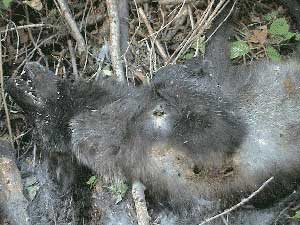
From an agency perspective, this kind of data can help provide adequate "management" of wolves but few detailed studies on Montana's wolf packs have been done. Instead, the number one management tool used by U. S. Fish and Wildlife Service has been killing. Depending on the year, between one quarter to one third of the wolf population in northwest Montana is killed by government control actions via "wolf management." This is public information which can be found in the agency's annual report. However, depending on which U. S. Fish and Wildlife Service biologist one talks with, the death toll could be closer to 50%. Some scientific data even suggests that losing one third of the wolves each year would produce an unsustainable population in the near future. So why are such apparently crude management techniques applied to wolves, especially when the U. S. Fish and Wildlife Service is pushing to have this threatened species removed from the Endangered Species List? Perhaps ignorance is an answer.
 |
As humans, we know little about wolves. Centuriesof fear and persecution have delayed our understanding of these creaturesand we are only beginning to study them with any depth. For instance,despite numerous studies over the past several decades, we are realizingonly now how important wolves are to the total health of an ecosystem. In fact we know that all predators, including wolves, play important rolesin the ecosystem. They are part of a system in which numerous organismsinteract to perpetuate each other’s existence. It is infinitely complex.
Therefore, it is the essence of my research to be engulfed by the Fishtrap pack's surroundings. To go where they go. To hear what they hear. To be there when they "talk" with one another. To see where and how they live. So as not to approach or disturb the wolves, most of these activities are done when the wolves are no longer present in the area. This requires a great deal of patience - something the process of wolf recovery does not have. To truly know about wolves is a tedious and time consuming endeavor. There is no way around this fact. Intolerance and convenience on our part only dull the truth about these animals.
So each day I return to the woods to be part of the process and attempt to understand the wolves' role within it. My glimpses into their lives has given me a new sense of humility - the more I find out the less I seem to know. Some days it seems like they are infinitely complex in their behavior while on other days they appear to be only a family trying to survive the day. I have learned, however, that rather than a "thing," a wolf pack as a dynamic process. It is greater than the sum of its parts. The parts consist of pack members interacting with the other and with their surrounding environment. The net result is a dynamic force that changes over time as the pack reacts to endless variations in the surrounding environment such as increasing or decreasing prey populations, prey migration, climatic changes, or when pack members come and go.
Wolves! Merely mentioning this canid species brings me a sense of satisfaction and peace. Visiting their world each day has taught me to respect them, not fear them. The result has been a life long process of inching closer and closer to the truth about wolves.